
The Spring of Danish Music. Talking with Jan Schmidt and Tom Jensen

Kateryna Ziabliuk
musician, writer
When it comes to jazz in Denmark, we are talking about something much deeper than just the sounds coming from the stage. Since the late 1940s, jazz here has served as an important social construct and a safe haven. Following World War II, many American soldiers—among whom were talented instrumentalists—remained in Europe, while others crossed the Atlantic later in search of recognition. During the infamous racism of the American 1960s, jazz titans flocked to Denmark in pursuit of creative and purely human freedom: Ben Webster, Dexter Gordon, and Kenny Drew. They didn’t just tour here; they put down roots, spent years playing at the legendary Jazzhus Montmartre, and ultimately forged a unique musical language side by side with local artists. American assertiveness blended with the Danish need for space, giving rise to a highly characteristic openness to stylistic experiments and "mish-mashes."
As is the case around the world, record labels became the main mouthpieces for this culture in Denmark. Despite the country's small territory and population, they managed to fill almost every imaginable stylistic spectrum. For over 40–50 years, SteepleChase Productions, Stunt Records, and Storyville Records (considered the oldest independent jazz label in Europe) have held a firm grip on the market, alongside a whole host of smaller independent labels and private publishing initiatives eagerly backed by the state. Among those most open to avant-garde and crossover sounds, Barefoot Records, ILK Music, and, of course, April Records—the protagonist of this story—stand out.
The occasion for our meeting with the label’s founders, Jan Schmidt and Tom Jensen, was a trip to the jazzahead! 2026 showcase. You could spot these vibrant personalities from afar at the welcoming and open-to-all Danish stand, where they passionately and warmly talked about everything they create and release. The first thing that catches your eye upon meeting them is their absolute openness to the interlocutor. For Jan and Tom, human relationships always take absolute priority over dry business.
Everything falls perfectly into place once you learn the label's fascinating history. Up until 2006, April Records released trendy electronic music, working with names like Underworld, Opiate, Kalaha, and Blue Foundation. Then, after a long hiatus, the founders took a trip to that very same jazzahead! and eventually began releasing... jazz. Deeply diverse, sometimes predictable, acoustic and electrified, innovative and revolutionary—there is a place for everyone in this musical family. Every album they put out is a reflection of the essence of not only the musicians, but also the publishers themselves, who know how to listen intently and help this music spread its wings across the globe.
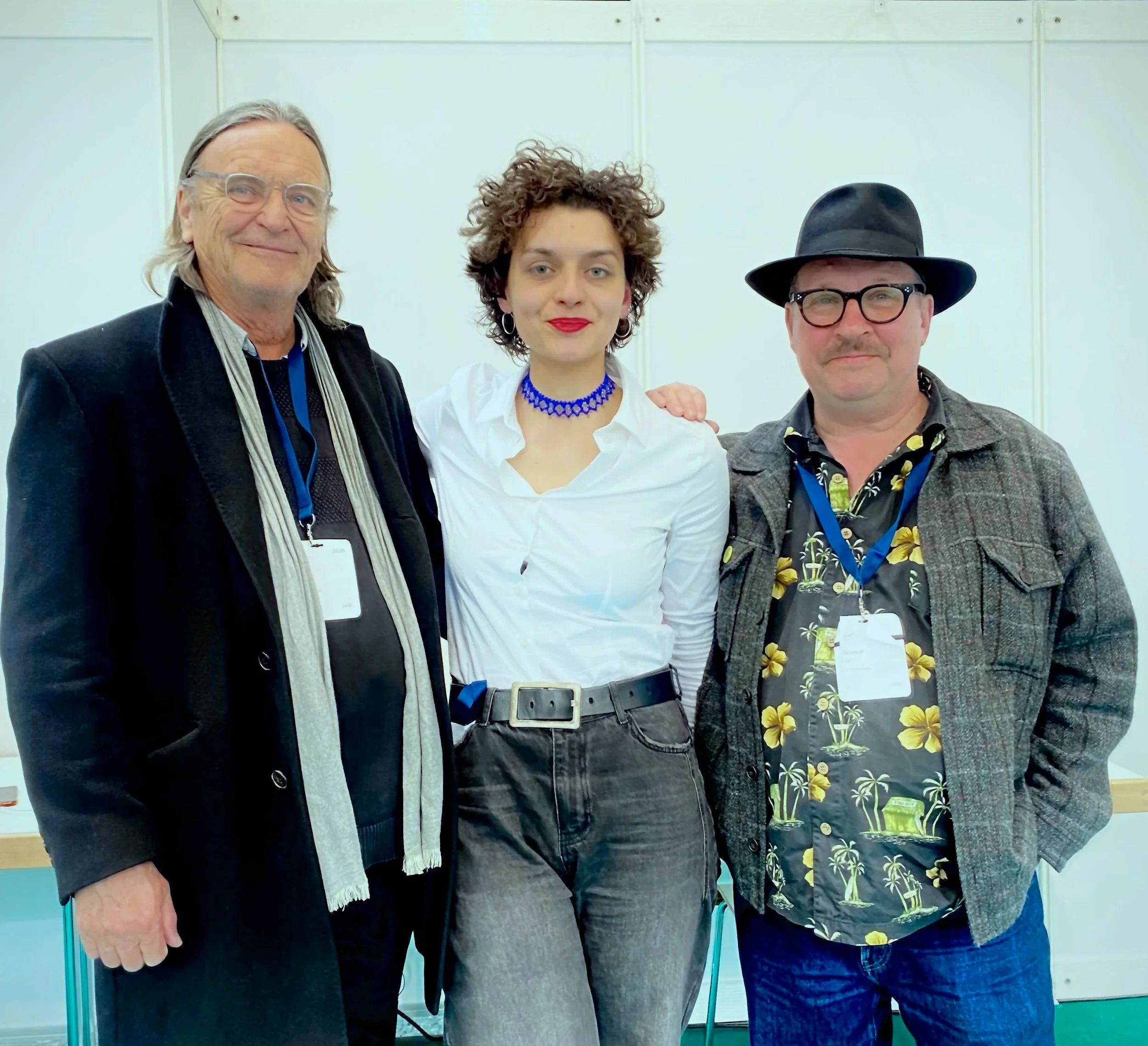
Tom, me (Kateryna Ziabliuk), and Jan. Private archives
Probably, I wouldn’t be the first to share the interest on April Records because of your beginnings with electronic music.
Jan: That's true. If I can go way back, we always listened to jazz, but it was electronic music that started the label.
The starts of a label are always different. Sometimes it's just an accident, sometimes it's a considered action with finances and stuff. How did it happen?
Jan: It was an accident. We worked in Copenhagen and were just watching the scene. At that time, back in '94, it was only electronic. Nowadays the vibrancy is on the jazz scene, but in the beginning of the '90s, it was only electronic.
Tom: We both, Jan and me, have always been curious and been out to figure out what's going on musically. It might be some other culture also, but mainly the electronic musicians. It started up as a down-tempo, ambient kind of beats, and over the years that turned into being more organic, including jazz elements.
Jan: At that time, in the '90s when we started in '94, it was called "New Jazz". We ended up, at that time, with electronic music with jazz add-ons. Now, it's jazz with electronic.
And how did the ambient scene look back in those days? What was happening and what places were you used to going?
Jan: Wow. At that time we went to Sónar Festival in Barcelona and different places in Europe, but also in Copenhagen a lot happened, I even can’t remember clearly the exact thing.
Tom: There was a lot of club scene, and it was vibrant. It’s basically like jazz is now in Copenhagen; if you go to jazz concerts today, it’s a very young audience. At that time, it was also vibrant, and we released about 70 albums from '94 until 2006—12 years. Then we stopped and nothing happened.
Jan: Nothing. I was kind of out of the business and I was DJing. Then Tom told me, "You have to go to jazzahead! in Bremen".
Tom: It was so nice. We went together. I fixed it so Yan got a DJ slot at the Danish showcase, and then there was a band that we both thought was so amazing. We were in different places in the concert, but we both met after and said, "Oh, I like that".
What was this concert? Do you remember?
Tom: It was at the Danish club night with a band from the city of Aarhus in Denmark. The name was I Just Came From The Moon.
They are the ones who you still have in the roster.
Jan: Yeah. That should have been the first album of our return, but it ended up being number 15 or whatever.
Tom: Then we talked about how we should start releasing records again. We were thinking about what it should be called, and then we thought, oh, we just reactivate the old label.
So the label didn't exist between the time you stopped and the return in 2020?
Tom: It existed. It just wasn't active. It was a hiatus—it never stopped to exist, but it was frozen.
What happened actually?
Jan: We saw that band and we talked about it. We’ve been knowing each other for years, and we said we need to start the label again. But it couldn't be just I Just Came From The Moon, so we started looking at what was happening on the jazz scene. I found out that wow, there's so much going on, like the electronic scene in the '90s. So many young, new, and fantastic players. It blew my mind in a way and I got a "second youth".
Tom: The first band we released, which should have been I Just Came from the Moon, ended up being four records at once. We thought we should release four records the first day: Little North, Cecilie Strange, and then we had to re-release an old record by the guy called Thomas Agergaard. That album he made in '99 was only released on a CD, and we always thought it was bad that it was never on vinyl.
Jan: I had been reading a book on Impulse! Records called The House That Trane Built. When Impulse started, they released four records at the same time, which was very different. We thought that if we release four records at the same time, we show that we mean business. We actually started at the worst possible time because these records came out in 2020. We were planning to make a big splash with a release party where all the bands were playing, but then the pandemic came and closed everything down.
Tom: So we could not make the big release party. But instead, it went quite well because people were at home and had time to listen. We got quite many offers because people also had time to record albums.
“We see it as a family and hope the artists see us as part of it, going in a direction together to lift everything up to a higher level.”
Do you have some musicians from electronic music that are reaching out to you right now?
Jan: Not really. But we have one of our bigger acts back in the '90s, a guy called Bjørn Svin. It might come out as a jazz album with a connection between some of our jazz musicians and him making a cooperation. We are talking about it and both want to do it. Now it's another time; times change and we change with the times.
What differences did you see between groups of musicians while you're talking with electronic musicians versus jazz musicians, in terms of their priorities?
Tom: It’s more or less the same way with the new scene. For us, we have an approach to the musician that we always use. We tell them, 'We like you, you’re doing fantastic music, and we want to release your record—but we have some terms you have to accept.' We take it from there. I think we are good at talking, but we’re also good at selling the product afterward.
There is a big difference between back then and now. When we did electronic music, many of the artists were 'bedroom musicians' working on laptops. Now, when we look at bands, we look for acts that are actually active live bands. In the old days, electronic music wasn't really about being an active live band; it was more about a different angle, like trying to get DJs to play the music. That is a big change.
How did you find them if they were bedroom musicians?
Tom: They found us, I think. Many people producing electronic music were sitting at home with home studios—that's what I mean by bedroom musicians.
And what about the approaches? Were you focused on just releasing music and making a roster, or had you extra ideas like live videos or merch?
Jan: When you sign or start working with a band, first of all, we have to like it. Then we get involved and we would like to put them in a direction we want to develop the act. I'm getting a bit "fluffy" here, but it's all about: can I like it or can I not?
What if the musician is not collaborating—for example, in difficult situations?
Tom: If we can’t work it out, then we have to make a "divorce," and hopefully we are still friends. Most of the people we release are people we know. Artists in the Copenhagen scene know each other and they have a clear picture of what we want. We always have a discussion about expectations, because if it's not ambitious enough—if it's just some side project—then it's not for us. We would be wasting each other’s time.
Jan: We look for some kind of "family vibe". A lot of artists we work with are the same musicians in different projects. We are doing a new album now with a girl called Emma Pilgaard, and in this band, we have Patrycja [Wybrańczyk] and Viktoria [Søndergaard], who we have also released. It ties pieces together, and when it ties pieces together from different countries even, it’s extra beautiful. We see it as a family and hope the artists see us as part of it, going in a direction together to lift everything up to a higher level.
Is that what makes you the happiest as publishers?
Jan: We love having some good music and coming to nice concerts! Of course, we don't forget the business side of it, because if we did, we would be dead in six months. We are very serious about distribution, PR, and marketing; if it's good for us, it's also good for the artist.
Tom: You have to be kind of a little stupid to make a business on records. You could probably make a much better profit in a coffee shop. But it's the passion that drives it. If we take something from scratch which is totally unknown and build it up over two or three albums, and these acts start to play bigger concert halls, then this is a pleasure. To see things grow—that’s the kick of it.
Jan: There is also the nuances of the financial side, PR side….
You certainly engage a bigger team.
Tom: Yeah, we have a network. It is a team that are similar to people from April Records — our partners. Then we have our PR team and we have some some partners around the world — in Germany, US, France, Japan.
Are there things from the past that you would never do again?
Jan: I would never start in music! (laughs) When that is said, it’s my life. Music is my life. Maybe what we learned is not to get over-excited. When you get over-ambitious and invest too much, you take a risk. We know what we’re doing now and what is a good level to do things. We don't say we should conquer the world; we do it our way, one step at a time.
Tom: Sometime an artist comes and says they want to play in America, and it's like, what do you want that for if you cannot even play in Sweden? If you cannot play in your neighbouring country, why do you want to go to America? Let’s relax and take one step at a time—try to play somewhere 200 kilometres away first.
What is your relationship with government money? Is there something that you’re doing together with the city?
Jan: We don't get government money, but we have organisations like KODA that take care of publishing rights. We are professional enough to get some of that support because they can see that if they give it to us, it starts work and it happens. We are also a publishing company; we could not make ends meet if we weren't.
Do you predict a stylistic switch again—maybe to heavy metal?
Yan: You know, good song is my favourite song, as someone said. You can play it in what way you want: metal, jazz, pop. But as an independent label, it's very important to be dedicated to your network. Nowadays, we wouldn't be able to release a pure electronic album because we wouldn't know how to promote it; we know the media and radio stations for jazz.
I think the scenes are fragmented now, but I don't think the audience is. I think the young people who listen to music today are more open-minded than they used to be. It used to be that if you were into electronic music, you were only into electronic music. Nowadays, I see people go to a jazz concert one day, an indie rock concert the next, and an electronic show the third day.
I shouldn't philosophise too much about how young people are, but I think we have developed this kind of 'zapper' culture—it's like when you’re switching through television channels. Everything is available, and they are taking it all in.
That’s a big difference now compared to when we were first releasing things. When we started the label, it was nearly pre-internet. Nowadays, everything is available, and I think there is a tendency where people just take it all in.
You can even hear it in some of the music we release; even if it is jazz, it isn't just one thing. It’s not like traditional hard bop. It’s throwing in a lot of different elements.
Do you feel that people expect labels to be diverse or rather more style-oriented?
Jan: We try to be diverse. The reason why April Records stopped in the beginning of the 2000s was because we were so focused on one music style, and that style nearly died overnight. So now we try to have a broader spectrum of sounds. If you are a jazz label, for example, and it becomes trendy to do spiritual jazz—if you specialize only in that one specific sound, like Matthew Halsall's Gondwana label—then you risk being left behind if people shift away from that sound and you don't shift with them. That is why we always have a lot of different sounds; we release so many records that we aren't tied to just one thing. We release close to 16 to 20 records a year, and not every record is for everyone. We have cinematic things, jazz ballads, piano trios, things that are more free, and party jazz.
It’s a deep statement. Also, it shows how freshness should be cared.
Jan: Absolutely. It’s about keeping fresh all the time and being open to different things. It isn't only about the market; it’s also about excitement because we aren't in a place where we are just into one kind of sound.
Actually, I think jazz has moved now to a point where people are taking everything in. Before, you had jazz musicians who played Bebop, and they played only Bebop. Now, we have musicians who play Bebop one day, smooth jazz the next, and more avant-garde the third day. I think many of the younger artists take in the whole of jazz history at once.
Imagine a person who wants to start an independent label. What would you say to them?
Tom: Don't! (laughs) No, you need that passion. We have seen so many people come and go. You need the passion for the music and you need to be realistic because this costs money. Don't go for the world to start with—start with your own town and slowly build it.
Jan: I think that if you are dedicated and focused, you can achieve most things you want in life. If you say you want to be a politician and end up in parliament, I think it’s realistic that you can get there if you dedicate yourself and work for it. But you have to go all in. You cannot do it halfway.
That’s also why we don't get involved in booking at the same time. Even if it seems like a good idea—because sometimes we release a record and nothing happens and we think, 'Oh, should we do the booking?'—you really need to be focused on what you are good at. If you are unfocused, you won't succeed. That’s my thought; you have to stay dedicated to your path.
Tom: Passion, then be focused, then be a bit practical and realistic.