
When Music Breathes – Origins, Memory and the Quiet Power of ‘Aroma’
Jacek Brun

Фото: Vasilis Bonis
Sometimes a single sound is enough to evoke an entire landscape. A resonance that does not end, but continues to travel – like a scent that lingers in the air long after the person who carried it has disappeared. The music of Eleanna Pitsikaki moves precisely within this in-between space: between closeness and distance, memory and presence, origin and freedom.
With her debut album Aroma, the Greek musician, now based in Germany, presents a work that resists any quick categorization. Jazz, Mediterranean sound traditions, transcultural improvisation – all of this is present, yet never as a constructed concept. Rather, this music feels like something that has grown naturally. Or, as Pitsikaki herself says:
“The music on ‘Aroma’ was not something I planned – it emerged completely naturally, like the scent of the sea carried by the wind”.
Crete as Origin – and as an Inner Landscape
Eleanna Pitsikaki grew up on Crete, an island where music is not merely a cultural practice, but part of everyday life. Landscape, myth, ritual and sound are inseparably intertwined. “Where sun and sea give birth to legends”, she found early access to musical traditions deeply connected to place and community.
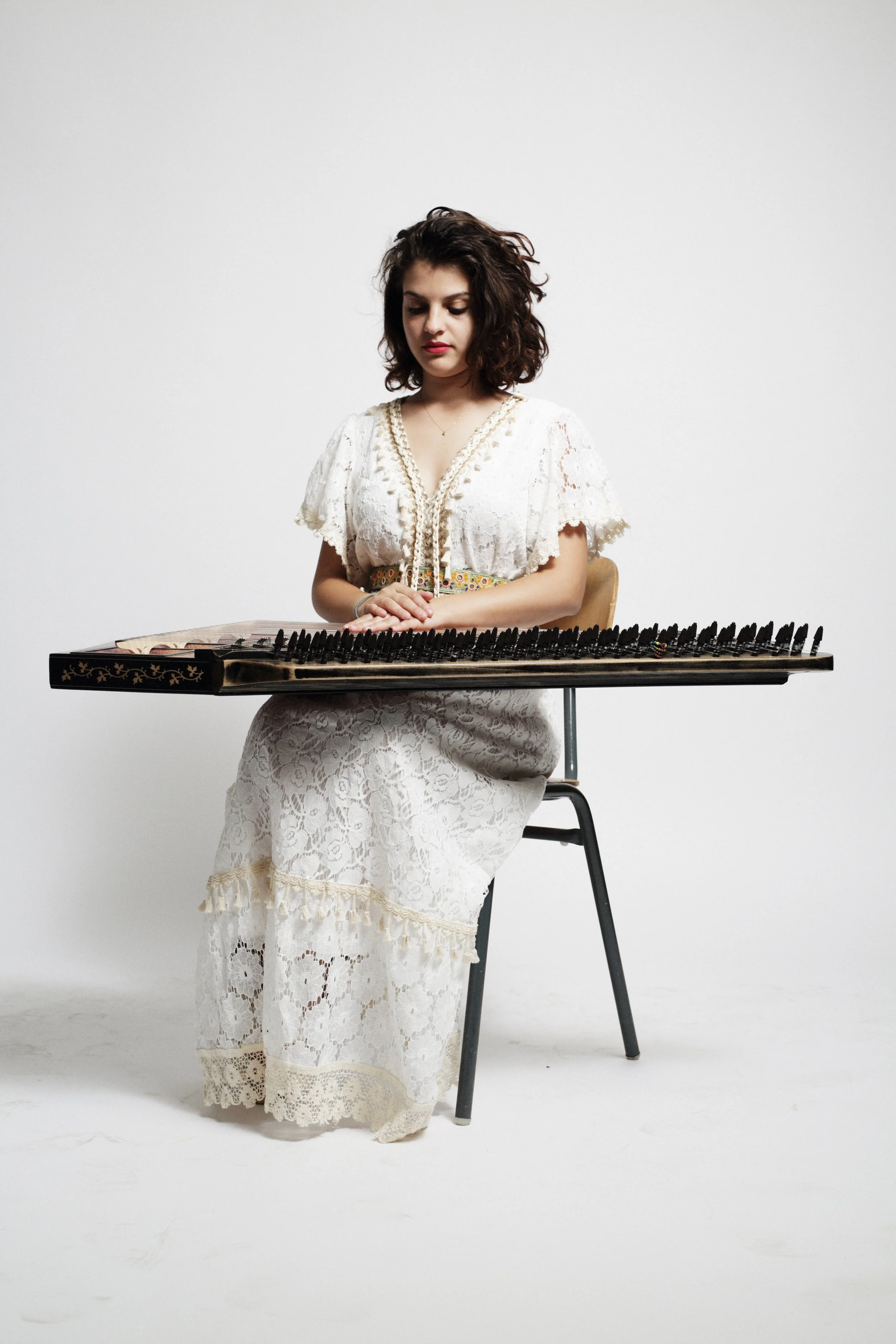
What is remarkable is that her central instrument – the qanun – does not belong to the typical instruments of Cretan folk music. And yet it became her true voice. Early on, she began connecting Byzantine sound worlds with the Ottoman maqam system, long before jazz entered her artistic horizon. Improvisation was, from the very beginning, something natural.
Later, as she immersed herself more deeply in jazz, she discovered not a rupture, but an expansion. Jazz became a space of freedom, not of departure. “Where jazz whispers of freedom, where Mediterranean melodies speak of salt, sun and longing”, her musical coordinates began to take shape.
The Qanun – An Instrument Between Centuries
In contemporary jazz, the qanun remains a rare presence. For Pitsikaki, however, it is not an exotic foreign body, but an instrument with a striking affinity to the improvisational culture of jazz.
“The qanun has always been a bridge between worlds for me – fragile, shimmering, and boundless”, she says of her relationship with the instrument.
Its history stretches far back – from ancient theories of proportion to Byzantine and Ottoman musical cultures. For Pitsikaki, this multiplicity is essential.
“It belongs to many countries and cultures. In our traditional music there is a lot of improvisation – like in jazz. Both are similar and yet very different”.
Within this tension, she finds her artistic freedom.
On Aroma, the qanun is not used as a folkloric symbol, but fully integrated into a contemporary sonic language. It improvises, responds, breathes – learning to speak in new ways.
Aroma – Music as Scent, Memory and Movement
The album title is carefully chosen. Aroma represents something invisible, fleeting, yet capable of leaving a profound impact. “I wanted to show that identity is not a fixed place, but a scent – fleeting, delicate and alive”, Pitsikaki explains. This idea runs throughout the entire album.
The compositions unfold slowly, layer by layer. Nothing pushes forward, nothing explains itself prematurely. Pauses are not empty spaces, but carriers of meaning. “For me, music must breathe like a living being – with silence, with pulse, with space to dream.”
This attitude shapes both the arrangements and the improvisations. It is not about virtuosity for its own sake, but about trust – in the moment, in the fellow musicians, and in the unspoken.
In jazz-fun’s review, the music was described as “organically flowing, free of artificiality – it breathes.” This breathing is not an effect, but a philosophy.
Places, Memory and Storytelling Without Words
Several pieces on Aroma are closely connected to specific places. Particularly striking is “Faraggi,” inspired by the gorges of Crete. Created during walks in 2020, the piece translates the quiet grandeur of these landscapes into sound. Echo-like motifs, wide arcs, a calm yet powerful pulse – music as inner topography.
“Place and memory are an essential part of me – they are part of my Aroma”, Pitsikaki explains. Her music resembles a backpack filled with experiences: Greece, Germany, and all the paths in between. “My music is like a breeze that travels from the mountains of Crete to the banks of the Main.”
Farewell is also a central theme. In “Apocheretismos” she interprets a traditional Cretan song of departure, connected to the voice of the late Kostas Mountakis. It is a piece about leaving, about letting go – and about carrying memory forward.
An Ensemble as Conversation
The album’s instrumentation is as unusual as it is coherent: qanun, kaval, keyboards, electric bass and drums. No hierarchy, no traditional lead instrument. Instead, an equal conversation.
“I wanted a sound that could move freely – grounded and open at the same time,” Pitsikaki says. The kaval brings breath and a connection to the folk traditions of Southeastern Europe, bass and keyboards create harmonic depth, while the drums connect pulse and presence. Every voice has space.



“This ensemble creates space for listening, reacting and spontaneous storytelling.” That is precisely its strength: it does not accompany – it narrates collectively.
Between Stage, Research and Transcultural Dialogue
Alongside her musical work, Eleanna Pitsikaki is also active in academic and cultural fields. She teaches, conducts research, is pursuing her doctorate at the Hochschule für Musik Mainz, and participates in transcultural networks. This work is not separate from her art, but part of its foundation.
“Research opens new perspectives, stories and methods that I transform creatively”. Thinking about music deepens the act of playing – without controlling it. Exchange, dialogue and openness are lived not only on stage, but beyond it.
A Quiet but Lasting Voice
With her album Aroma, released by Timezone Records and supported and advised by Marita Goga – Music Arts Conception, Eleanna Pitsikaki presents herself as one of the most remarkable emerging voices in the European jazz landscape.
Her music is not loud, not demonstrative. It resonates in a lasting way – like a scent that remains. Or, as she herself expresses it, she hopes listeners will think after hearing it for the first time:
“That was so beautiful… we have to see her live”.
A wish that sounds less like marketing and more like an invitation. An invitation to listen, to remember – and to breathe.