Berlinde Deman: “My Serpent has melancholic, characterful and deep dark sound”
Bernard Lefèvre
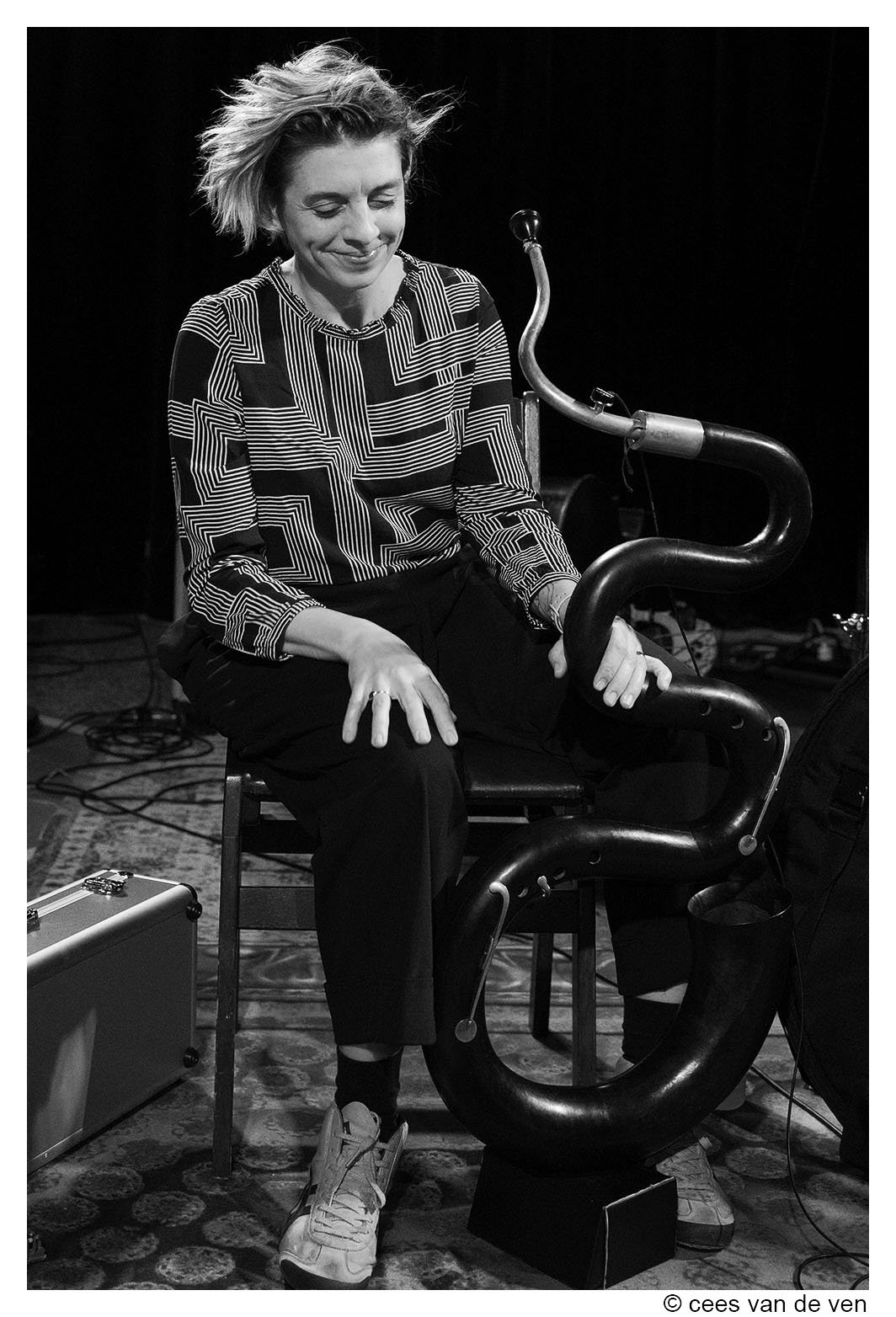
Berlinde Deman is the only female jazz tuba player in Belgium. And what makes her more unique: she is the only serpent player there. You may know her as the tuba player from the Flat Earth Society Orchestra. Her fascination with the serpent, an S-shaped wind instrument developed in Auxerre around 1590, started fifteen years ago. Six years ago, she began an intensive and personal study of this rare and capricious instrument through self-study tuition. At the end of last year, her first solo serpent album, “Plank 9”, was released on the New York label Relative Pitch Records.
I grew up in a musical family. My grandmother played jazz piano, my mother double bass in the Sint-Kwintens-Lennik brass band. One day, my mother bought a bruised rusty and adorable tuba in an antique shop. I was eight and immediately fascinated by that impressive instrument. I was determined to play it. So off to music school I went. In Gooik, people were a little surprised when I, a young girl, chose such a heavy instrument, almost as big as myself.
I insisted: it was the tuba or nothing. The director eventually made a support so I could hold it. By the time I was twelve, I was already playing quite well. At sixteen, I was already playing with Bart Maris in the street theatre Excelsior. During my conservatory years, I worked on a production with Dimitri Leue in a big band conducted by Benjamin Boutreur. Not long after, Peter Vermeersch from Flat Earth Society called, and that's how I got into jazz. I already wanted to study jazz, but there was no jazz tuba teacher at the conservatory. The only course teaching jazz was the double bass. But they referred me to the trumpet class, which neither did not match. In order to continue playing the tuba at a high level, I eventually obtained my master's degree in classical music.
Who did you listen to and who taught you what?
Initially, I listened to Howard Johnson and Michel Godard; there were few jazz tuba players to look up to at the time. Meanwhile, I listened to a wide range of music. I have always been a musical omnivore: Tom Waits, Anouar Brahem, Yusef Lateef, Lhasa, Jeff Buckley, Moloko, Jill Scott, and later more drone/experimental: Mazen Kerbaj, Etienne Nillesen, Susana Santos Silva, Maria Bertel, Martin Taxt,...
After my master's degree in classical music, I took improvisation lessons in Liège with Michel Massot and Garrett List. For the rest, I discovered and learned a lot myself, while playing, thanks to the versatility of the tuba, from klezmer, Balkan, classical and contemporary work to theatre and jazz.
I have been trying to break away from classical music for almost twenty years now. Strictly playing from the sheet music feels oppressive to me. Playing with Flat Earth Society was a turning point in that respect: working with the moment, the humour, the risk. In the classical world, everything is often very serious. Over the years, I improved my ability to let go and improvise, especially with the serpent, which is an unpredictable instrument in itself.
How did you discover the serpent?
About fifteen years ago, while listening to oud player Rabih Abou-Khalil, I heard Michel Godard playing the serpent for the first time. I could not believe my ears: that melancholy, that dusty, mysterious sound.
I was immediately enchanted and wanted to learn to play the serpent too. But it turned out not to be that easy. No one in my circle played the serpent, and finding one was not so easy. I also read online that the instrument was unplayable, inherently out of tune. Godard's serpent turned out to have been built by the Swiss Stephan Berger. In England, I did find an affordable alternative made of carbon fibre, but I didn't want to take that risk, as the material of an instrument determines its sound.
A few years later, I heard about Pierre Ribo, a new serpent maker, and what's more, he was based in Brussels. That's how I finally found my instrument.
How did you learn to play the serpent and how would you describe your sound?
Because there was no jazz training for tuba, I followed a classical training. That's where my search began.
With the serpent, that search became even more radical: there was no training and hardly any references. In Belgium, Christophe Morisset and I are the only professional serpent players.
In France, Michel Godard and Patrick Wibart are important references. Michel's tone is dusty and extremely agile. Patrick's tone in early music is very concrete and clear. My tone is somewhere in between. My serpent has a melancholic, characterful and deep sound. The serpent by its very nature has a warm sound.
People sometimes associate the sound with a womb or deep roots. Melancholy is also a trap; it is easy to evoke that feeling with the serpent. Three notes and everyone is touched. The challenge for me is to make the sound dangerous. Therefore I use effect pedals. The serpent originally was played in the church where its sound fully flourish. In halls where those acoustics are lacking, I have to use my imagination by employing effect pedals and sounds such as extended techniques and quarter tones. In this way, I want to make the serpent sound like a living and unstable instrument.
Where do you get your inspiration?
First and foremost from my daughter Lonne, to whom I also owe the title Plank 9. Two years ago, she practised her handstand every day. Each time, she wanted to move one plank further away from the cupboard she was leaning against. Every day I heard: ‘Plank 9, Mummy!’ That was her goal by the end of the summer. At the time, I was making plans for a solo album and realised that this was my own Plank 9. She still can hardly believe that I named the album after that.
Plank 9 also features the song Hum of Bees. It was written in Michel Mast's garden, where bees settle in his pergola for a week every year. I discovered that the dusty serpent sound makes it very easy to imitate the buzzing of bees, dreamy but also threatening at the same time.
I find inspiration everywhere. I read a lot. One book that stuck with me is “Six Months in the Siberian Woods” by Sylvain Tesson. His voluntary seclusion in a log cabin touched me. You can hear that silence and concentration in my music. Not as a direct reference to one piece, but as a whole set of impressions.
I also feel a lot of poetry in the sounds...
I'm glad you noticed that. I love to write and am always working with language. For me, poetry is nothing more than a world captured in a single sentence. That is strongly connected to my music. I use few notes. I want to say everything with four or five notes.
You transcend all musical boundaries...
The beginning of my serpent story is my duo hum. with Mirko Banovic. He wanted to manipulate my serpent with electronics. I eventually started using effect pedals myself. I love the dirty and unpredictable nature of it.
I continued in the same vein with sound artist Rutger Zuydervelt, which resulted in the albums Luchtwezen and Stuutjes.
Graindelavoix, which specialises in early music, also came my way. Voice and serpent: tonal colours that are made for each other.
From the scene of improvised music, Dutch saxophonist and clarinettist Ab Baars crossed my path. Together with Joost Buis, we recorded the album “Cecil's Dance” in 2024.
Other projects I played on: “It's Gone” by Jef Neve, “Secular Psalms” by Dave Douglas, and collaborations with Spinvis, B.O.X/Dez Mona, MikMâäk and La Floresta.
What does your musical future sound like?
I am fascinated by silence. By what happens just before and just after a sound. I want to create a project with my own lyrics and music that is based on silence.
At the same time, I am listening more and more to sounds that are normally perceived as disturbing. Renovation noises. Cars in the street. The coughs of my chain-smoking neighbour. I want to use those sounds as inspiration for a more rhythmic repertoire.
I was a performer in many projects. Now I want to create with the serpent itself. Let my ideas grow into music. Build something of my own that can scour and touch deeply.
Concert agenda 2026:
20 March: trio with Adilia Yip and Hester Bolle, Le Senghor, Etterbeek
4 April: solo serpent: brdcst, AB Brussels
28 April: FES album release, HaConcerts Ghent
9 May: trio with Patricia Vanneste and Matthijs Bertel, Stormloop, Herentals
13 June: solo serpent, Het Onument, Kortrijk