
Aleksandra Kryńska: “I like starting things over”
Krzysztof Komorek
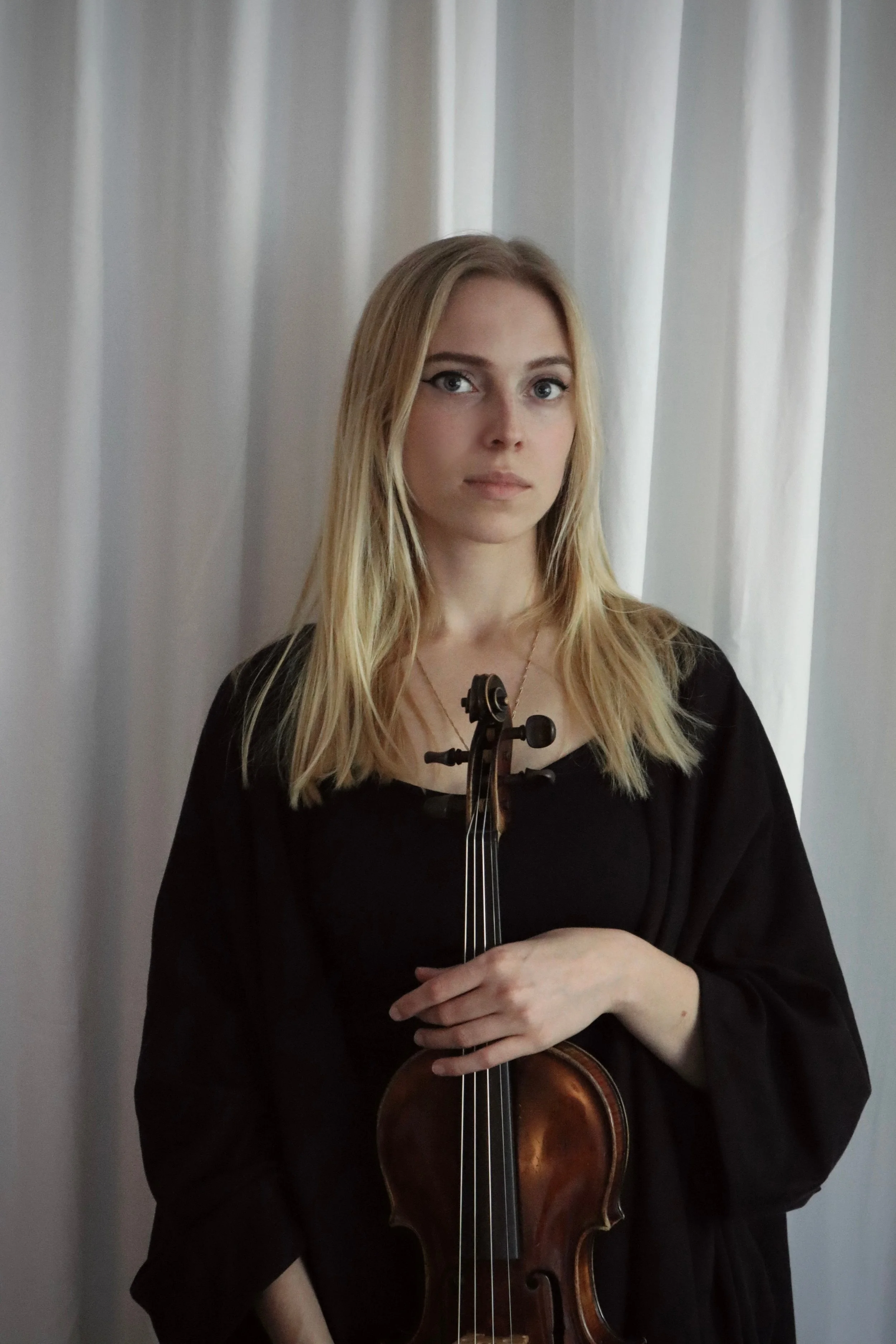
Photo: Mat Kubaj
Aleksandra Kryńska grew up in the world of classical music, and her career in that field can be considered very successful. She graduated from the Academy of Music in Krakow. She collaborated with esteemed and prestigious classical music ensembles, including the Sinfonietta Cracovia and Amsterdam's Royal Concertgebouw Orchestra. As Orchestra member she performed with luminaries of the contemporary classical scene—Albrecht Mayer, Krzysztof Penderecki, the Labèque sisters, Rainer Honeck, and Gábor Boldoczki. She participated in the "50 for the Future" program initiated by the Kronos Quartet.
When did your interest in pursuing music professionally appear?
I decided to go to the Academy of Music in my second year of high school. I studied in Professor Wiesław Kwaśny's class. Professor Kwaśny is part of the "old guard" of Polish violin playing; he was demanding, but as it later turned out, also very understanding and supportive.
Yet, unexpectedly, you suddenly found yourself in the world of jazz.
I like starting things over. I have a feeling that then, everything is still possible. I think it's both a curse and a blessing. That's how it was in 2017 when I went to the Festival & Masterclass course-competition in Piła. I was almost exclusively involved in classical music, practiced a lot back then, and went to improvisation workshops to "break out." The lecturer was Adam Bałdych. Having nothing to do with jazz, I received the "Jazz Personality" award then.
Did improvised music immediately become your new fascination then?
At first, I wasn't that into improvisation. In 2018—a year after the competition—when I wasn't accepted into the master's program for classical violin in Dusseldorf, I decided to try to get into the Jazz Department at the University of Music in Warsaw. I was 23. I succeeded. The beginnings were exciting but also stressful; I felt pressure to prove something. It annoyed me that I was at such a low level; I wanted rapid progress. I realized that the violin isn't particularly suited as a "sideman" instrument, and you have to figure out something of your own, so I just started writing pieces. It was a path through torture: I had no workshop skills, writing a few bars on the computer took me a lot of time, and there were huge theoretical gaps. I did and tried to learn everything at once.
Meeting with figures deeply rooted and recognized in the jazz world surely helped.
At the university, I had great lecturers; besides my main tutor Mateusz Smoczyński, there was Maciej Obara. His classes were absolutely mind-opening. I created my first band, the KRVNSKA QUARTET, with Piotr Andrzejewski, Maciej Baraniak, and Igor Falecki. We played my compositions. The guys were the best in the world and were very understanding of my scores, which aspired to be professional. At that time, I still had one foot in the classical world, but I felt that someday I would have to decide on a more decisive separation of my worlds.
What became the turning point and helped in making the decision?
I had a crisis; I didn't take up jazz master's studies, I wanted to quit. And contrary to my plans, I qualified for the International Jazz Platform [prestigious workshops for musicians in Lodz focused on improvised music], which I completely didn't expect. During those workshops, a lot of things turned upside down; I returned to playing and met people made from the same clay, which made me feel less alone. I went to my first jam session at SPATiF [renowned, Warsaw based club for improvised music and jazz]. Karolina Szewc – head of SPATiF - was there; we immediately hit it off. I felt like I was in a second home there; later she considered me for various concert configurations.
Concerts at SPATiF became an opportunity for artistic meetings and starting regular collaborations.
Yes. Thanks to them, I played with, among others, Raphael Rogiński, and I appeared on the "Music For Peace" recording session, where I met trumpeter Piotr Damasiewicz. We created a duo, mostly improvising; we played together for two years and did a tour in Japan as part of Jazz Po Polsku programme [A concert project showcasing Polish jazz internationally. Its name can be translated as „Jazz - The Polish Way”]. It was an important collaboration; I learned a lot.
In 2024, you reached the finals of the prestigious Seifert Competition.
My career wasn't heading towards a solo path. I didn't have competition successes; I knew I wasn't really suited for that. I don't have the spine of a racehorse . Competition in artistic fields seems like an absurdity to me. But we live in times where quantifiability makes it easier to slot us into a box. It's a pity I'm starting to observe this more and more often around me. I had no expectations and didn't want any. After a few years of learning and improvising, I simply wanted to check what stage I was at on this new path. Later I also found out that, among others, Dominik Wania on piano would be playing with us. It was my dream to play with him someday, so I was overjoyed. I managed to reach the finals, and I consider that my success. A lot of good things happened. Did it help me in any way? I met great people and musicians, and the Seifert Foundation took my album under its patronage. I think thanks to the competition I somewhat marked my presence in the music world a bit more, but that might also be a bit of an overstatement.
Year 2025 could be called breakthrough.
Definitely. First and foremost, my album, recorded a year earlier, was released. When the moment came that I felt it was time to gather myself, record, and release original material, I decided to create a new formation. I invited the aforementioned Piotr Damasiewicz, Szymon Mika, Michał Aftyka, Bartosz Szablowski.
We met for the first time the day before recording the album, then three days in the studio; we recorded the material. I'm also happy with the concerts I played then—including one with Paal Nilssen-Love's Large Unit.
A follow-up to participating in the International Jazz Platform is the project ÄETHER—three of the female artists in it were participants of the Platform.
I was invited to create the Polish-French ensemble ÄETHER with Amalia Umeda, Maelle Debsbrosses, and Adele Viret. Our quartet performed for the first time during the Jazzdor Strasbourg Berlin Festival. Then we played in Łódź at Summer Jazz Academy Festival and in Strasbourg. We have plans for more concerts. Each of us brought a piece or pieces. We worked on the material in Berlin for three days. It was a demanding experience. In the end, we managed to find a common language, and I think above all, we created music—and that doesn't always happen.
In ÄETHER, alongside improvisation, one can find influences of contemporary classical music. So you haven't completely broken with your former artistic worlds.
Each of us has larger or smaller classical roots. We play acoustically. So I think it was unavoidable.
So a lot is happening, but you are still drawn to changes.
Speaking of new beginnings, I plan to present myself in yet another guise; I'm working on new material, learning from musician friends, and developing further. We'll see what happens, but I don't know if I need to know.